

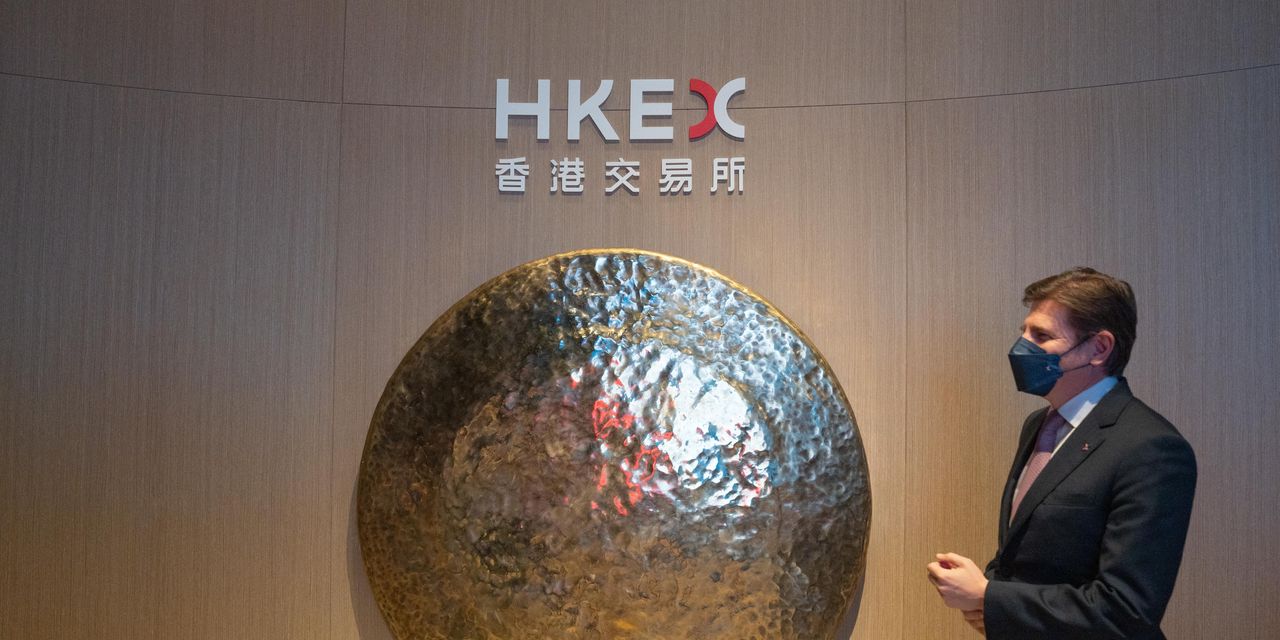
Hong Kong’s equity capital markets are perking up, after a punishing first half for what has long been one of the world’s largest venues for stock issuance.
A recovery in initial public offerings and other share sales would be welcome news for the many companies eager to tap investors in the city for funds. It would also be a boost for global investment banks, after a lean period in which they have brought fewer companies to market, often via much smaller deals than in the good years.
Hong Kong IPOs raised $2.67 billion for the first half of the year, down 91% from the $30.48 billion of stock that was sold in the same period last year, according to Dealogic. The figures include both first-time listings by companies whose stock wasn’t previously trading anywhere and listings by companies that already had a presence on another exchange.
SHARE YOUR THOUGHTS
What’s your outlook on Hong Kong’s equity capital markets? Join the conversation below.
Against a challenging backdrop, a few companies have chosen to go public even if it means raising little or no new money. Some companies such as the electric-vehicle manufacturer
NIO Inc.
have opted for listings by introduction, which doesn’t involve selling any new shares. The cloud-platform company
Tuya Inc.
raised around $18 million in gross proceeds, and paid about half of that sum in underwriting fees and other listing expenses.
Some big stock offerings from mainland China—technically follow-on share sales, since the companies are already listed at home—could help reopen the market. Lithium producer
Tianqi Lithium Corp.
recently priced a share sale at the top of its earlier price range, raising $1.7 billion, and its Hong Kong-listed shares are due to start trading on July 13. Shanghai-listed
China Tourism Group Duty Free Corp.
, which late last year postponed a Hong Kong listing, has revived that plan, filing an application in late June.
Some private companies are also gearing up for first-time share sales, such as Soulgate Inc., a metaverse-based social-networking company backed by
Tencent Holdings Ltd.
The potential recovery follows a period of relative strength for Hong Kong stocks, and Chinese shares more broadly, which have regained some ground since mid-May. While the S&P 500 dropped 16% in the second quarter, the city’s flagship Hang Seng Index edged down just 0.6% over the same three-month period. The MSCI China Index rose 2.2% for the same period. In June, cash poured into major exchange-traded funds tracking Chinese shares.
Still, some market participants wonder how readily investors will absorb the pent-up supply of IPOs, and say several well-performing listings are needed to help the market reopen smoothly.
“It’s not just a one-deal thing,” said Kenneth Ho, head of equity capital markets at Chinese bank Haitong International Securities Group. “You can’t have just one good IPO and then the rest flops.” Prospective IPO candidates include consumer, technology, healthcare and electric-vehicle-related businesses, he said.
In June, the chief executive of
Hong Kong Exchanges & Clearing
said the exchange operator had about 180 companies in its pipeline that had filed to go public, a figure that is close to an all-time high. Some companies are braving potentially choppy markets to meet funding needs, or to stick with predetermined timelines, such as to allow exits by private investors, deal makers say.
“We’re going to continue to see high-growth companies needing to raise capital,” said Udhay Furtado, co-head of Asia-Pacific equity capital markets at Citi. However, Mr. Furtado said it wasn’t clear if the price expectations of issuers and investors had lined up enough to allow deals to go ahead, given elevated volatility and a rapid drop in valuations in the first half of the year.
The downturn has led to global banks working on fewer and smaller deals. Dealogic data shows that for the first half of 2021,
Bank of America Corp.
,
Citigroup Inc.,
Credit Suisse Group AG
,
Goldman Sachs Group Inc.,
JPMorgan Chase
& Co.,
Morgan Stanley
and
UBS Group AG
collectively worked on 23 new listings in Hong Kong worth $28.1 billion in total. For the comparable period this year, the same banks have handled 11 such deals, worth an overall $1.3 billion.
Some investors remain cautious. Jim Kwok, chief executive of Hong Kong-based multifamily office Topaz Family Office, said the firm’s clients generally have weak appetite for IPOs this year.
The firm will handpick a few deals to test the waters, though it will need to see the market stabilize more solidly before it participates more fully in IPOs like it did last year, Mr. Kwok said. “It’s all because the market sentiment is really, really weak,” he said.
In an illustration of that poor sentiment, some newly public companies have struggled since listing. Shares in logistics platform
GogoX Holdings Ltd.
, for example, at one point this week traded at just half their IPO price. The company had raised $85 million in a scaled-back IPO last month.
Franco Ngan, CEO of China-focused fund manager Zeal Asset Management, said his firm won’t hesitate to participate in good-quality IPOs. But he said he was also watching for policy changes from Beijing. Mr. Ngan said while “policy has already become more supportive,” toward Chinese tech firms, his firm was watching how this was implemented in practice.
Write to Dave Sebastian at dave.sebastian@wsj.com
Copyright ©2022 Dow Jones & Company, Inc. All Rights Reserved. 87990cbe856818d5eddac44c7b1cdeb8