

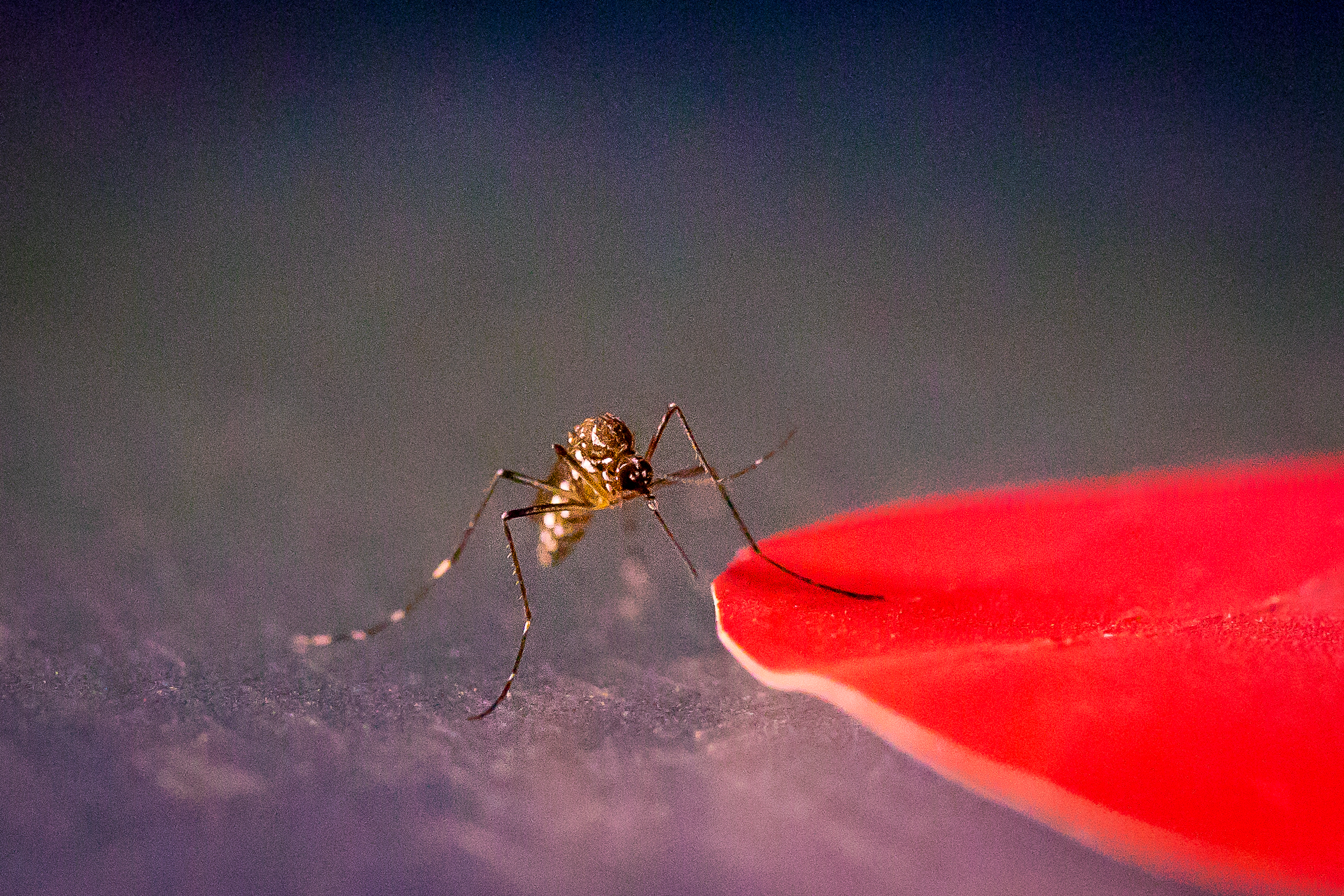
Using a high-tech wind tunnel built for mosquitos, researchers at the University of Washington have uncovered how the pests seek out humans, first detecting carbon dioxide from our breath and then zeroing in on colors in the skin.
“The carbon dioxide turns on their visual system and then they start searching for you,” lead author Jeffrey Riffell, a biology professor at the University of Washington, told GeekWire. The findings could lead to new types of mosquito traps.
Marten Edwards, an entomologist and chair of the biology department at Muhlenberg College, called the findings a “major advance” and said the study was unique for its “rigorous testing of the interplay between distinct sensory inputs: carbon dioxide detection and vision.”
Mosquitos can detect carbon dioxide from about 100 feet away, and maybe further, Riffell said. And they are known to seek high contrast objects that appear darker against a lighter background.
Riffell and his colleagues sought to determine if mosquitos were also attracted to specific colors. Tsetse flies, for instance, are attracted to blue, which has led to the use of blue-colored traps to keep the disease-causing pests at bay.
The UW insect wind tunnel is set up to find out what mosquitos like. The 7-foot-long apparatus can analyze the flight patterns of up to 100 insects simultaneously. And like a metaverse for mosquitos, it can display different colors as dots on the floor, and even subject the pests to different odors, such as one their favorite: carbon dioxide.
“It’s almost like playing Wii with a mosquito,” said Riffell. “You can start playing these kind of virtual reality games with them.”

The researchers tested about 12,000 mosquitos, tallying 1.3 million separate flight trajectories. The studies were performed on Aedes aegypti, which transmits diseases like dengue fever, Zika and yellow fever, and Anopheles stephensi, which transmits malaria.
In a study published Friday in Nature Communications, the researchers report that mosquitos homed to the red and orange colors of human skin — including one called “vile 45,” which “matched the putrid orange tone from individuals who use cheap tanning lotion,” according to the study’s methods section.
The mosquitos were only attracted to these colors if they first got a whiff of carbon dioxide. The mosquitos did not respond to green, purple, blue or white, though they liked cyan.
And everyone’s skin looks the same to a mosquito. Orange and red are dominant hues in people of all shades and tones of colors, said Riffell, “It doesn’t matter what tone of skin you have, or shade.”
“Nobody knows if mosquitoes ‘perceive’ what we view as ‘color,’” said Edwards. But the mosquitos “responded with extra vigor and determination to the wavelengths of light that are reflected from human skin.” That they only responded to color when exposed to carbon dioxide “makes intuitive sense — since mosquitoes generally don’t bite people who are not breathing,” said Edwards.
The researchers also assessed mutant mosquitos with impaired ability to detect carbon dioxide and found they could not zero in on red and orange colors — neither did mutant mosquitos with impaired red-orange vision.
The study’s findings were backed up by experiments with human subjects from various ethnic groups, who willingly signed up to place their hand in a box filled with mosquitos.
The findings flesh out the understanding of how mosquitos find humans and bite them.
Carbon dioxide provides a long-range trigger that activates the mosquito visual system. They are then primed to seek human skin, which they can detect by color from five to 15 feet away, estimates Riffell. Mosquitos can also sense body temperature and skin odor, which determines if they will bite.
“This trick of combining senses is ancient and is probably shared with other mosquitoes,” said Edwards of Riffell’s new study. “The research has broad applications, including the design of better mosquito traps.”

The new study comes on the heals of another recent study, on people who are “mosquito magnets.” People who are “highly attractive” to mosquitos have distinct skin odors, concluded the preprint study, led by researchers at Rockefeller University.
Riffell notes that the use of khaki by the military in tropical environments may have origins in mosquito control. Khaki minimizes contrast with the environment and mosquitos do not respond to its mix of green, blue and white hues. Similarly, the military changed its dress shirts from dark to light blue more than 100 years ago in part to discourage the insects.
Meahwhile, Riffell’s team is working on making better mosquito traps. “These traps haven’t changed in like 100 years,” he said dismissively. “They’re using a lot of white. Mosquitoes hate white.”
The team has tinkered with color and other aspects of mosquito traps available from hardware stores. In unpublished studies, their modifications have resulted in a five to ten-fold higher capture rate.
The new study also involved researchers at the University of California, Santa Barbara and the University of Freiburg (Germany).