
Brands will no longer be limited to physical spaces — or physical products — as the value of digital goods (in the form of non-fungible tokens), keeps growing. The idea is that instead of going to a physical store and picking up your favorite products, you could simply purchase them in the metaverse and get them delivered at home. Sounds like Deliveroo, we know, but in the metaverse there’s much more than you can do at the same time you’re shopping, like attending a metaverse concert or gathering with your friends.
Experiences will be increasingly integrated into one space, creating more opportunities for users. Or that’s at least the plan of companies like McDonald’s, which will be adding a whole range of services to its standard home delivery options.
Before we get to the details, it’s worth taking a look at the key metaverse ideas that advertisers and ad ad agencies should be aware of:
Virtual reality (VR)
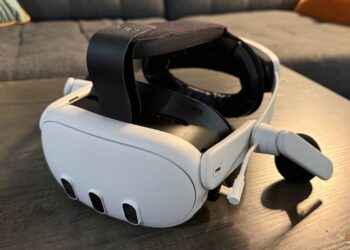
Virtual reality is an immersive and interactive experience in a simulated environment. You can enter a 360-degree environment with the help of an interface like a head-mounted device. This way, VR provides visual, sensory and auditory feedback, allowing users to immerse themselves fully in virtual worlds and environments, like the metaverse.
Virtual reality technology has been around for quite a while now, but it has only started maturing and becoming more accessible in recent years. More recent advancements have made the use of VR and its interfaces, like VR headsets, much more practical, widespread and accessible.
Augmented reality (AR)
Augmented reality is a technologically enhanced version of the real world, achieved by superimposing a computer-generated image in a real-world, physical space. Visual and sound stimuli are added to enhance immersion.
Mixed reality (MR)
Mixed reality is a broad technological category that refers to “mixed” experiences that result of an overlap of human and computer processing input. As described here, Mixed reality technology overlays artificial content onto the real world and enables the artificial content to interact with the real world scenery. VR and AR lie on the mixed reality spectrum, which extends between physical and digital worlds.
Extended Reality (XR)
Extended reality encompasses virtual reality (VR), augmented reality (AR) and mixed reality (MR), and any form of immersive technology capable of extending reality by blending real-world elements and virtual world. XR includes human-machine interactions that have an effect on cognition and senses, like VR headsets, AR glasses and even implants.
Avatar
An avatar is a computer-generated representation of users in a virtual world or metaverse. In essence, it’s your virtual persona.
Blockchain
Blockchain technology provides a way to store information digitally that is nearly impossible to change or hack. Blockchain also powers cryptocurrencies, like Bitcoin and Ethereum, as well as being the technology behind non-fungible tokens (NFTs).
Cryptocurrency
Virtual currency, or cryptocurrency, is the main means of payment in the metaverse. This type of currency is kept in digital wallets and secured through highly complex cryptography. There is no central regulation or oversight over cryptocurrency as it goes through decentralized systems, which help issue and track cryptocurrency tokens.
Non-Fungible tokens (NFTs)
An NFT is a unique digital asset stored on a blockchain. It represents real-world items like music, art, collectibles, and much more. And NFT will give you true digital ownership of a one-of-a-kind asset.