

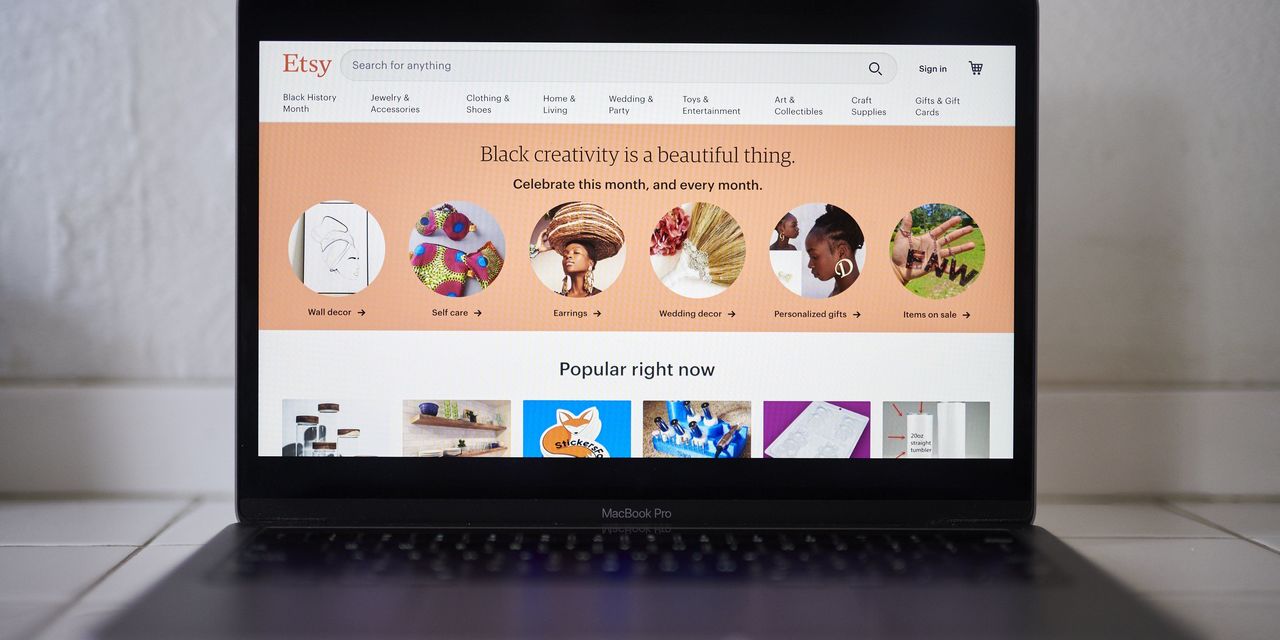
The term “side hustle” sounds almost illicit—like Walter White’s secret crystal-meth business in “Breaking Bad”—but it is actually both common and respectable. The real high might lie in the stock market.
A survey from web-automation company Zapier found that as of December 2020 one in three Americans had a side hustle—a job in addition to their full-time work—and that about a quarter planned to start one in 2021. Side gigs aren’t new but have been gaining in popularity, especially with younger people. A survey from Lending Tree found millennials the most likely demographic to have one, with half reporting a side hustle as of 2020, followed closely by Gen Z at 46%.
Forerunner Ventures this year named the side-hustle as one of its top themes for future investing. As a result of the “great resignation,” workers of all ages are seeking creative ways to make money at home when convenient while they search for a proper second act.
E-commerce platforms like
eBay,
Etsy
ETSY -9.29%
and
Shopify
saw their shares skyrocket in late 2020 and early 2021, catalyzed by the pandemic. They have given up much of those gains, but the underlying trends are robust. YipitData estimates roughly 1.1 million merchants made a sale on Etsy.com in January, up 76% from two years earlier. Shopify’s gross merchandise volume this quarter is expected to be nearly four times what it was just three years ago.
Freelance online marketplace
Fiverr International
has seen its shares plummet since peaking in early 2021, but its recent fourth-quarter results and revenue guidance were encouraging. JP Morgan analyst
Doug Anmuth
says recent stock weakness has likely been driven in part by sector rotation out of small-cap growth stocks. He points to strong retention trends from pre- and post-pandemic cohorts and product investments driving up spending per buyer.
SHARE YOUR THOUGHTS
Do you have a side hustle? Join the conversation below.
Angi Inc.’s
Handy is a two-sided marketplace for home services where providers can lend a hand. Handy co-founder
Oisin Hanrahan,
recently named Angi’s chief executive officer, is working to make Angi as a whole more millennial-friendly. And Care.com, bought by
IAC/InterActiveCorp
before the pandemic, enables instant booking for those seeking care and offers an easy way for caregivers to more flexibly participate in the workforce. Shares of Angi and IAC are down 64% and 36%, respectively, over the past year.

In ‘Breaking Bad,’ a chemistry teacher finds a second income by applying his expertise.
Photo:
AMC/courtesy Everett Collection
Some platforms need to broaden their appeal. Social marketplace
Poshmark
seems built for the professional side-hustler. While the platform had 4.5 million active sellers as of September, according to a securities filing, 83% of its active users were female and 80% were millennials or Gen Z as of the end of 2019. Similarly, image-sharing platform
said in its public-offering filing that its user base included half of all U.S. millennials but that two-thirds of its users were female. Poshmark and Pinterest’s shares are down 76% and 66%, respectively, over the past year, in part because their platforms have failed to attract a broader user base.
And then there is traditional social media. These days more people seem to be applying to reality TV shows with the hope of scoring social-media side gigs than are applying to top colleges with the hope of securing a conventional day job. Once focused solely on advertisers, social-media companies now compete to win the favor of these budding celebrities in hope that they will draw more eyes to their platforms. For a while,
Snap
was offering $1 million a day to popular creators for their content. Its video platform contends with the likes of
Meta Platforms
’ Instagram and ByteDance’s TikTok, whose website touts “the sky is the limit!” for creator earnings. Creators provide popular content on or around which platforms can serve ads, among other things.
Shares of Snap and Meta Platforms are down 60% and 51%, respectively, over the past six months, mostly because of temporary ad-targeting headwinds from
Apple.
But in the long run, both companies are building stables of tools for the next-gen creator and consumer alike, such as augmented-reality lenses, virtual reality and the metaverse. Meta said last June it had more than 1.2 million active Shops across Facebook or Instagram and over 300 million monthly Shops visitors. Separately, Facebook’s Marketplace platform had more than 1 billion monthly users as of last April.
Eurie Kim,
general partner at Forerunner Ventures, said she sees side hustles as a lasting shift accelerated by the pandemic. Forerunner’s research from last year showed 35% of Americans surveyed expressed greater interest in self-employment after the pandemic, with the percentage higher for some demographics, such as parents of young children.
The only thing more lucrative than a side hustle might be investing in the companies that enable them.
Write to Laura Forman at laura.forman@wsj.com
Copyright ©2022 Dow Jones & Company, Inc. All Rights Reserved. 87990cbe856818d5eddac44c7b1cdeb8