

With Thanksgiving and Black Friday in the rearview mirror, we’re entering the home stretch of 2022. Congratulations, you made it through another rough year.
We’ve traditionally reserved this Thanksgiving period to have a little fun while shining a light on the year’s biggest failings in tech, with a roundup affectionately known as CNET’s annual Tech Turkeys. In the past, the ribbing was good natured, pointing out silly products or a random faux pas at a conference (hello, Michael Bay!).
Then the problems across Big Tech piled on. Congressional hearings, election-swinging misinformation, and privacy-invading breaches became a regular thing. Add to that a world-halting pandemic, inflationary pressures, a Russian-led war, earthquakes, and an environment where one catastrophe drops after another. All together, it can be more than a little dark and overwhelming.
So instead of gawking at some of Big Tech’s most embarrassing flops and failings, we’re going to try to get some use out of them. Let’s take a look at what lessons we can take away from those Tech Turkeys.
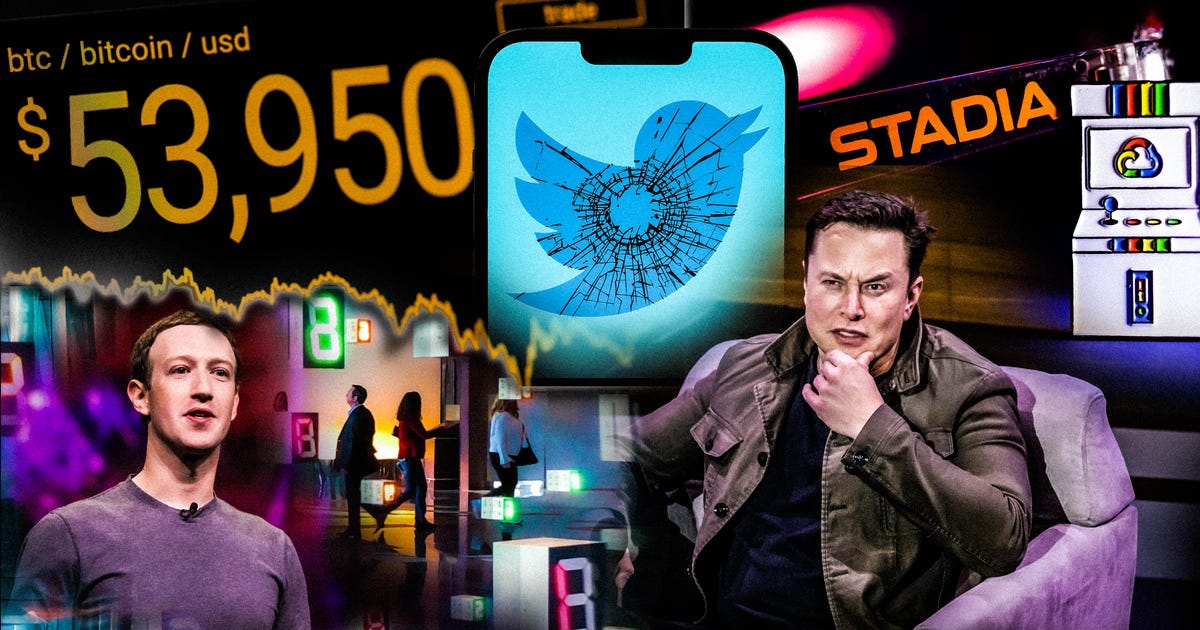
Lesson 1: Chaos is the new norm for social media. #ElonIsDestroyingTwitter.
Watching a train wreck happen in real time can be riveting, as I noted just two weeks ago. And right now there’s no implosion more fascinating than Twitter.
Over the last few years, Facebook, Instagram, YouTube and TikTok have had their own share of entanglements, from political controversies to data privacy concerns. But few have faced the kind of self-imposed existential risk that’s before Twitter since Tesla CEO Elon Musk bought the social network for $44 billion on Oct. 27. Though it’s only been less than a month, there’s enough drama that CNET’s Queenie Wong and Sean Keane put together a timeline of all the crazy that’s happened since Musk took over. It’s updated virtually every day.
What’s Musk done? He’s laid off half the staff — and then tried to hire some of those 3,700 people back once he realized that someone needs to keep the lights on; openly discussed the possibility of filing for bankruptcy as he faces a deadline to pay back $13 billion he borrowed to buy Twitter; and pushed a new, more “hard-core” Twitter 2.0 that requires staffers to pledge their fealty to Musk (and not criticize him), which reportedly resulted in 1,200 engineers and other key employees heading for the exits. He also offered a paid verification option that immediately led to people impersonating big companies like Eli Lilly — to devastating effect — and reinstated the accounts of Kanye “Ye” West and Donald Trump (Trump hasn’t yet used the newly rebooted account).
It’s clear Musk had buyer’s remorse almost immediately after he struck a deal with Twitter. But if he was going to commit to this deal (even if it was to avoid going through a protracted legal fight with Twitter’s board), there should’ve been some kind of a game plan in place. I mean, isn’t Musk supposed to be a genius? Instead, he’s so far just been offering one ridiculous tweet after another.
The most apt thing Musk has tweeted since the takeover: “How do you make a small fortune in social media? Start out with a large one.”
It could (arguably) be worse: Look at Ye’s purchase of right-wing social media platform Parler.
Lesson 2: The crypto crash is a reminder that there’s no easy money.
At the beginning of the year, NFTs were a thing — even if most of the planet didn’t understand what they were. Bitcoin and other cryptocurrencies were flying high, and FTX wasn’t yet a household name.
Fast forward 11 months and bitcoin and the rest of the crypto market are still struggling to recover from a massive crash that wiped out $2 trillion (that’s with a T) of market capitalization over the summer. This month, leading centralized crypto exchange FTX imploded after rival Binance backed out of a plan to acquire it. Investigations ensued, and FTX turned out to be a house of cards with liquidity issues and serious risk issues that finally came due. So crypto ends the year like it started the year — on everyone’s mind, only now it’s for the worst possible reasons.
It’s a reminder that these gains aren’t guaranteed, despite the relentless rise of crypto over the last few years. It’s also a reminder that when it comes to managing money, maybe some tried-and-true business fundamentals do matter.
But even with all that, somehow NFTs are still a thing.
Lesson 3: The metaverse might be the future, but not anytime soon.
It was a little more than a year ago that Facebook went all-in on the metaverse and renamed itself Meta to symbolize CEO Mark Zuckerberg’s commitment to the new virtual platform. (Never mind the controversy and baggage the company was trying to shed by dropping the Facebook name.)
In case anyone is feeling FOMO for not partaking in the metaverse: Don’t worry! It’s definitely still not a thing.
Virtual reality had a brief moment during the lockdown, with Meta a specific beneficiary from increased sales of its Quest 2 VR headset. All it took for virtual reality to be appealing was a pandemic and lockdown rules trapping us in our homes.
But the metaverse hasn’t taken off as expected, and Meta has felt the pain in a real way (by that, we mean it’s cost the company serious money). Meta nee Facebook’s investment in a platform that hasn’t taken off happened at the same time the company’s core advertising business faltered in a weakened economy. The result led to the canning of 11,000 employees, or 13% of Meta’s total workforce.
This year’s Meta Connect conference brought the Quest Pro, which has gotten a lukewarm response and isn’t meant for consumers, with a price tag of $1,500. Also, the company’s sales pitch kind of fell flat when, during a keynote demonstration, it presented pre-rendered, motion-captured digital legs as “real” virtually rendered ones in an attempt to suggest the tech is further along than it really is.
If you’re going to bring digital legs to a party, they better be legit.
Lesson 4: Nothing lasts forever. And some things don’t last long at all.
In 2022, we bid farewell to a few notable services and some we barely knew existed. The takeaway: Even the most heavily hyped product or service may disappear in a flash.
That’s what happened with Google Stadia, which launched two years ago in what was supposed to be a bid to revolutionize how we game. But Google shut it down in January. The cloud gaming service should’ve been a no-brainer, especially as gamers logged more hours during the pandemic, yet it was beset by early technical glitches and a seeming lack of interest and investment from within the company.
It doesn’t help that there’s plenty of cloud gaming competition from Xbox and PlayStation, among others.
Another thing that came and went: Spotify’s Car Thing, an auto accessory that was unveiled in 2021 but didn’t hit the market until February. Within five months, the music streaming service killed the product, citing low sales volume. What’s that tune this calls to mind? Could it be Oops!… I Did It Again (2022 was actually a good year for Britney Spears).
Likewise, Amazon Glow was a mash-up of a tablet and projector designed to connect children with their relatives through interactive games. (CNET reviewer Bridget Carey called the $300, 4-pound tablet a “bulky Frankenstein monster of a gadget.”) It barely lasted longer than Car Thing, lighting up kids’ faces for about six months before getting shut down in October.
A product family with longer legs, but with a fair share of baggage, was Facebook Portal, video chat devices that got a little time in the sun during the pandemic when we were desperate to connect with our relatives. Meta quietly eighty-sixed the line in June as it moved away from consumer products. The move wasn’t a huge surprise, since the products launched amid a LOT of questions about Facebook’s ability to handle consumers’ privacy. CNET editor Megan Wollerton, in fact, told our readers that you shouldn’t buy the Facebook Portal TV.
Lesson 5: There’s such a thing as too much shopping.
I understand the irony of saying something like that just days after Black Friday and in the midst of Cyber Monday, but keep in mind that those particular celebrations of consumption have been around for a while now. They’re practically institutions. (By the way, you can check out our Cyber Monday deals here.)
Amazon’s OG Prime Day, typically held in July, is on its way to becoming another such phenomenon. But the online retailer went and pushed its luck in October with a second Prime Day (cough, I mean, Prime Early Access Sale, which rolls right off the tongue).
The two-day sale came and went, but it was clear that customer interest fell far short of that for the summer Prime Day. Considering it took place just a little more than a month before Black Friday, I’m shocked it didn’t do better. Shocked.
Lesson 6: Things are just getting more expensive, and we need to be smarter about money.
Inflation was a big buzzword this year, and many of us are feeling the effects of rising prices. It’s hitting us at the gas station, in the supermarket and, of course, in the tech world.
Meta, which had subsidized the price of its virtual headsets to drive adoption, jacked up the price of its 2-year-old Quest 2 by $101, to $400. Earlier this month, the monthly subscription for YouTube Premium rose by $5, to $23. Disney Plus raised its fees in August, and Apple boosted the prices for its various Apple Music and TV Plus plans in October.
Some of the increases are inevitable, which means you’ll have to be smarter about managing your budget and expenses and deciding which movie and TV franchises you really want to watch — even as the streaming services offer ad-based tiers that are cheaper.
CNET has a whole section on how to save money, which is especially important as the tough times hit everyone.
Lesson 7: Solutions to the chip shortage problem aren’t coming anytime soon.
One of the biggest contributors to the shortage of everything from cars to graphics cards was the ripple effect of pandemic-induced slowdowns in Asia, particularly those affecting components like semiconductors. The situation exposed the fact that we’re heavily reliant on just a few suppliers for the little chips that power practically everything.
Intel a year ago laid out a grand plan to restore chip manufacturing in the US and has invested in next-generation tools to make it happen.
But in October the company hit a big bump in the road when it reported a third-quarter profit that fell 85% from the year ago period and when it warned that its full-year sales would be lower than it expected. It was a rough report and a reminder that Intel’s ambition to make the US more self-sufficient from a chip perspective is going to take years to become reality.
Lesson 8: There’s nothing to fear from AI. Yet.
Let’s end on a bizarre note. There’s been a lot of talk about the dangers of artificial intelligence and where the technology goes from here. One Google software engineer, Blake Lemoine, took those worries a step further by publicly expressing his concerns that the company had achieved AI sentience.
He’s referencing Google’s Language Model for Dialogue Applications, or LaMDA, which is supposedly smart enough to understand a joke.
Google responded by firing Lemoine, saying he shared internal information.
Your mileage may vary with AI systems. There’s Meta’s BlenderBot 3 chatbot, which during a weird conversation with CNET reporter Queenie Wong said it wasn’t crazy about Facebook. Or Galactica, another Meta AI system, which was designed to ingest millions of fact-based science papers and “organize science,” but which had to be scrapped because it spewed misinformation. On the other side, there’s DALL-E, which uses AI to cobble together images from the text you type in. It’s odd enough to mention in any roundup of 2022.
Despite Lemoine’s fears, it doesn’t appear that AI systems will be crossing that line into sentience anytime soon.
For that, we may just have to wait until next Thanksgiving.