

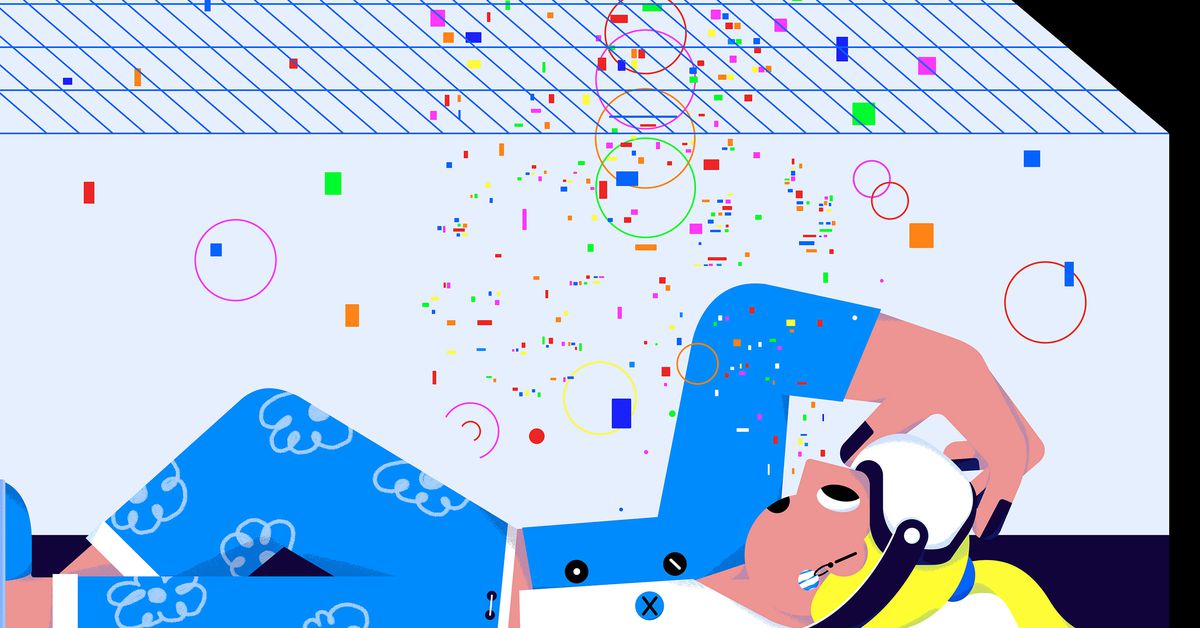
I ripped off the headset, afraid I was going to throw up. I shouted for help. My partner found me in the fetal position in a cold sweat on the bathroom floor.
I had spent just an hour in the metaverse dressing my avatar, making faces in the virtual mirror, and learning to raise my virtual wristwatch to adjust system settings. Now, I couldn’t open my eyes without seeing the virtual grid echoed in the tile floor, demarcating the boundary where I had crossed into unsafe territory.
I had been aware that nausea was a potential risk of VR. I had read accounts of cybersickness, motion sickness, “VR hangovers.” I’d even known that women are more likely to experience disorientation in VR because of subtle physiological differences from men. Where biology diverges, engineering exacerbates: historically, women’s average interpupillary distance surpassed the lower limit of most VR headsets. In other words, women are more likely to get motion sickness from VR because the headsets were literally not built for women. Despite all my research, I wasn’t prepared for the visceral reality of how awful a bad VR trip would make me feel — physically, mentally, and emotionally.
A fellow analyst had said we shouldn’t listen to anyone who has an opinion about the metaverse if they haven’t spent any time there themselves. Trained as a social scientist and ethnographer, I was in agreement on this point — I couldn’t knock it til I tried it myself. I wanted to overhear the voices of underage children messing around with their parents’ headsets and see the media execs with brand names in their handles wandering around the walled garden test bed of the future. I had to see Biggie Smalls in concert for myself. I was even prepared for potential harassment, ready to flip on a virtual bubble of personal space should the need arise. So I strapped into Meta’s Quest Pro to experience the metaverse for myself.
I hadn’t even entered Horizon Worlds when the nausea hit. I was mapping the territory of my tiny Manhattan bedroom office. Meta’s Guardian boundary system is designed to prevent you from gouging your shin on the coffee table while shuffling around in the equivalent of a clunky plastic blindfold. As I reached to pick up the handset controllers I had set down on the bed to adjust my headset, the Guardian was triggered.
My proprioception had been disrupted, and my interoception system signaled that things were not alright by flooding my nervous system with nausea
Warnings blasted red, the Tron-like grid became porous, and I was shown the Quest Pro’s grainy passthrough view of my bedroom. Though I knew I wasn’t in any real danger reaching into the space of my bed, the warning was jarring. My avatar arms intersected with the feed view of my real hands, confounding my expectations of where my limbs ought to be. My proprioception had been disrupted, and my interoception system — the mind-gut connection — signaled that things were not alright by flooding my nervous system with nausea.
Fight or flight kicked in. I ripped the headset off and lay prone on my bed. I alternated between closing my eyes to calm down and opening them to reorient myself in the familiar room. I may have even said out loud to myself, “I am in my bedroom, and I am safe.” But the nausea did not dissipate. I ran to the bathroom, fearful of emptying my dinner onto my Berber rug.
My partner found me lying on the bathmat. Wondering how best to triage, he googled “VR nausea” and found plenty of evidence that the awful VR side effects were common, did not require immediate medical attention, and would eventually pass. He patiently sat with me and helped me reorient.
I had no script for how to pull myself out of the bad trip. I had tried VR before some years ago — at a conference in 2014, I sat suspended in a hammock chair as the simulation parachuted me down to the ground. Ironically, I had managed not to get sick while floating through virtual air. But this time, I hadn’t made it past setup.
The visceral effects of VR are real. This is by design — engineers are focused on making the VR experience as immersive as possible to achieve a sense of what Mark Zuckerberg calls “presence.” And immersive VR experiences designed to create a sense of presence will inevitably have an impact on our sensory systems, including those that regulate our sense of safety and orientation in the world.
On top of that, some of the most compelling use cases for VR involve similar levels of intensity and risk. Stanford VR researcher Jeremy Bailenson has proposed a useful framework for deciding whether a scenario is worth exploring in VR as meeting the DICE criteria: Dangerous, Impossible, Counterproductive, or Expensive and rare.
Immersive VR experiences designed to create a sense of presence will inevitably have an impact on our sensory systems
Big Tech is betting that extended reality — virtual reality, augmented reality, and the rest — will usher in the next generation of hardware computing interfaces, leading us into an era of spatial and embodied computing. Responsible innovation principles need to extend beyond privacy and data stewardship to consider the duty of care for users in emerging immersive, embodied computing interfaces. Technologists will need to have a duty of care to users for the impacts of the interfaces so intimately entangled with our sense of our bodies and reality itself.
So what responsibility do platform and device makers have to users? Taking care in immersive digital environments is a matter of consumer protection and public health.
“Don’t make devices or simulations that make people sick” is simple enough to say, but after my bad VR trip, I started thinking about what a harm reduction framework would mean and what VR aftercare might look like.
I’m not the only one thinking about the care protocols for immersive environments. One of the buzzier applications for VR is medical care. Experimental treatments use exposure therapy to help trauma patients manage their PTSD triggers and chronic pain patients manage their pain responses. Other corporate training programs simulate Black Friday retail crowds or active shooter scenarios — extreme, chaotic situations that require calm and measured responses.
Coming out of VR is not just a matter of taking off a headset when trauma is involved
Those applications follow strict protocols and are managed closely by clinicians or disaster response professionals. Unlike recreational VR, people are paying close attention to how users are transitioning in and out of these intense therapeutic or educational environments. Coming out of VR is not just a matter of taking off a headset when trauma is involved.
Micaela Mantegna, a legal scholar who specializes in video game policy and extended reality, has a particularly apt metaphor here. She argues that we need the equivalent of a deep sea diver’s decompression table to emerge safely from immersive technologies. Divers stop at designated depths to release excess nitrogen that builds up in their system. That excess nitrogen would otherwise cause the bends — with divers doubling over in pain due to joint pain, numbness, paralysis, and impaired coordination. Mantegna, who has also suffered from motion sickness and nausea from VR, argues that as much attention is paid to immersing ourselves in VR experiences should be paid to emerging, or offboarding processes that allow us to “re-enter our physical body and space after experiencing virtual embodiment.”
Deep sea diving isn’t the only extreme sport to offer an apt metaphor for care. Mountain climbers have protocols for mitigating altitude sickness on ascent, stopping at base camps along the way. Astronauts undergo rigorous training to deal with shocks to the system under extreme shifts in gravitational force and the mental and emotional tolls of isolation in space.
These extreme immersive environments put intense stress on the mind, body, and emotional state of the adventurer. Forms of aftercare are baked in for good reason. But when it comes to virtual reality, the user is left to fend for themselves without even a list of best practices, let alone assistance.
As with extreme sports, we might look to other contexts that echo the intensity of experience to borrow metaphors of care that could inform practices, protocols, and rituals for transitioning safely from immersive interfaces.
What would VR decompression look like to ease our mind-body connection as we transition from virtual spaces? What resources for grounding, reorienting, and re-realization do we need as we transition between alternative reality interfaces?
Psychedelic harm reduction
If cyberspace is a “mass consensual hallucination,” as William Gibson described it, we might also borrow from psychedelic harm reduction tactics for handling a bad VR trip. From distortions, paranoia, and hallucinations to dissociation and derealization — all of these states can manifest as side effects of psychedelics and VR alike.
Researchers are even developing VR experiences to mimic the therapeutic effects of psychedelics without the chemical side effects. VR safety instruction manuals with section headings like “Choosing Your Safe Activity Space” read like pioneering psychedelic researchers’ emphasis on the importance of “set and setting” to ensure a positive experience by priming the user with the right mindset and providing a sense of safety. Perhaps years under surveillance capitalism had primed me not to feel safe and secure strapped into the heavily subsidized eye-tracking hardware deemed Zuckerberg’s best hope for new growth. VR trip sitters could help remind users that their bad feelings won’t last forever and help ground them with sensory anchors, mantras, and physical touch.
BDSM aftercare
VR aftercare could borrow from the consent-based sex communication and kink communities. BDSM practices model express negotiations of boundaries and clear communication for intense intimate experiences. Doms and subs check in throughout a scene. BDSM aftercare accounts for the intensity of the experience and serves as a transition from a heightened emotional and physical state and mitigates dysphoria.
Consent-oriented communication around intimacy has made aftercare a modern element of even vanilla sex. Imagine the VR version of a safeword that allows users to pause the experience without having to fumble with buried settings or resort to ripping off the headset entirely in a heightened state of dysregulation. Interface design could initiate a safety script to allow for a smooth transition when a limit is reached or even when the headset battery is about to run out.
Reverse culture shock prep
Even repatriation offers a productive metaphor for thinking through reverse culture shock in transitioning from an immersive experience. The United States I returned to in 2020 was dramatically different from the one I left in 2015. After five years in Singapore, I had changed, too. Leaving in the height of pandemic lockdown was the expat equivalent of ripping off the VR headset — no ceremonial visits to favorite restaurants or social gatherings to say goodbye and mark the transition. What is virtual reality if not a foreign digital land? Returning to the realities of home requires a mindful transition.
Lacking any of these metaphors for reorientation, I instinctively fell back on techniques I had learned in therapy, grounding and reorienting my body in my real, physical environment to help regulate my nervous system after this bad VR trip.
The cold of the enamel bathtub against my back felt good. I took off my socks to better connect my feet to the ground. My dog came and licked my toes and reminded me I was safe with my pack. After I started to regain my bearings, my partner guided me to the bed and tucked me in with my grandmother’s weighty afghan.
Hours later, I woke up, opened my eyes to the familiar dark edges of my room, and knew I had safely returned to reality.