

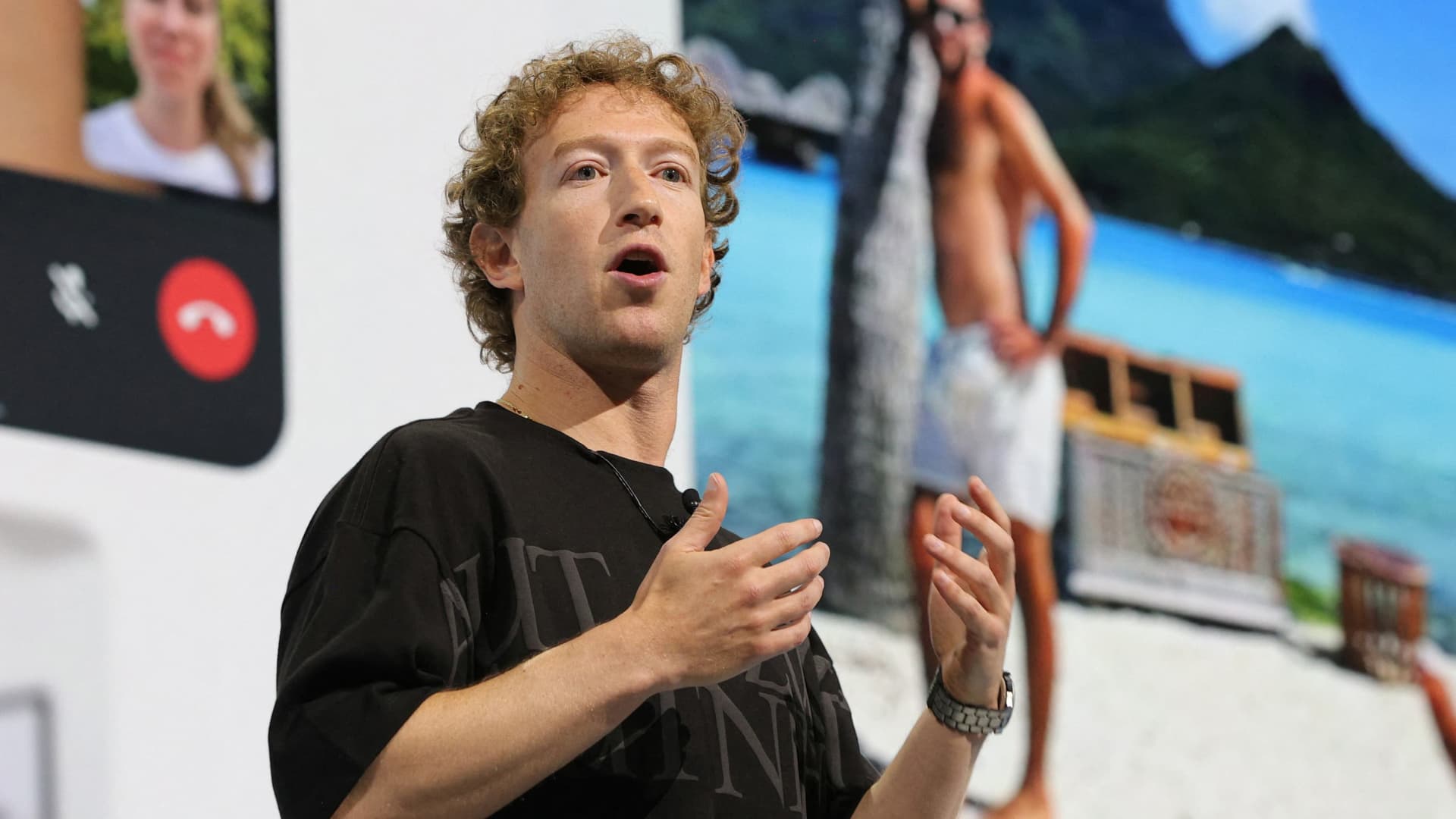
Meta CEO Mark Zuckerberg makes a keynote speech at the Meta Connect annual event at the company’s headquarters in Menlo Park, Calif., on Sept. 25, 2024.
Manuel Orbegozo | Reuters
Meta CEO Mark Zuckerberg was so optimistic last year about his company’s Llama family of artificial intelligence models that he predicted they would become the “most advanced in the industry” and “bring the benefits of AI to everyone.”
But after including a whole section on Llama in his opening remarks during Meta’s earnings call in January of this year, he mentioned the brand name only once on the latest call in October. The company’s obsession with its open-source large language model has given way to a very different approach to AI, one focused around a multibillion-dollar hiring spree to bring in top industry talent that could help Meta take on the likes of OpenAI, Google and Anthropic.
As 2025 comes to a close, Meta’s strategy remains scattershot, according to insiders and industry experts, feeding the perception that the company has fallen further behind its top AI rivals, whose models are rapidly gaining adoption in the consumer and enterprise markets.
Meta is pursuing a new Llama successor and frontier AI model, codenamed Avocado, CNBC has learned. People with knowledge of the matter said many within the company were expecting the model to be released before the end of this year, but that the plan now is for that to happen in the first quarter of 2026. The model is wrestling with various training-related performance testing intended to ensure the system is well-received when it eventually debuts, said the people, who asked not to be named because they weren’t authorized to speak on the matter.
“Our model training efforts are going according to plan and have had no meaningful timing changes,” a Meta spokesperson said in a statement.
With its stock underperforming the broader tech sector this year and badly trailing Google parent Alphabet, Wall Street is looking for a sense of direction and a path to a return on investment after Meta spent $14.3 billion in June to hire Scale AI founder Alexandr Wang and a handful of his top engineers and researchers. Four months after that announcement, which included Meta purchasing a big stake in Scale, the social media company raised its 2025 guidance for capital expenditures to between $70 billion and $72 billion from a prior range of $66 billion to $72 billion.
“In many ways, Meta has been the opposite of Alphabet, where it entered the year as an AI winner and now faces more questions around investment levels and ROI,” analysts at KeyBanc Capital Markets wrote in a November note to clients. The firm recommends buying both stocks.
At the heart of Meta’s challenge is the sustained dominance of its core business: digital advertising.
Even with annual sales in excess of $160 billion, Meta’s ad targeting business, driven by massive improvements in AI and the popularity of Instagram, is growing revenue north of 20% a year. Investors have lauded the company for using AI to bolster the strength of its cash cow and to make the organization more efficient and less bloated.
But Zuckerberg has much grander ambitions, and the new guard he’s brought in to push the future vision of AI has no background in online ads. The 41-year-old founder, with a net worth of over $230 billion, has suggested that if Meta doesn’t take big swings, it risks becoming an afterthought in a world that’s poised to be defined by AI.
Until recently, Meta’s unique position in AI was the open-source nature of its Llama models. Unlike other AI models, Meta’s technology was made freely available so third-party researchers and others could access the tools and ultimately improve them.
“Today, several tech companies are developing leading closed models,” Zuckerberg wrote in a blog post in July 2024. “But open source is quickly closing the gap.”
He’s since started changing his tune. Zuckerberg hinted over the summer that Meta was considering shaking up its approach to open source after the April release of Llama 4, which failed to captivate developers. Zuckerberg said in July that, “We’ll need to be rigorous about mitigating these risks and careful about what we choose to open source.”
Avocado, when it’s eventually made available, could be a proprietary model, according to people familiar with the matter. That means outside developers wouldn’t be able to freely download its so-called weights and related software components.
Some at Meta were upset that the R1 model released by Chinese AI lab DeepSeek earlier this year incorporated pieces of Llama’s architecture, the people said, further underscoring the risks of open source and hammering home the idea that the company should overhaul its strategy.
The company’s high-priced AI hires and leaders of the recently launched Meta Superintelligence Labs, or MSL, have also questioned the open-source AI strategy and favored creating a more powerful proprietary AI model, CNBC reported in July. A Meta spokesperson said at the time that the company’s “position on open source AI is unchanged.”
The Llama 4 flub was a significant catalyst in Zuckerberg’s pivot, the people said, and also led to a major internal shakeup. Chris Cox, Meta’s chief product officer and a 20-year company veteran who was hired as its 13th software engineer, no longer oversees the AI division, formally known as the GenAI unit, after the botched release, the people said.
Zuckerberg went on a spending spree to retool Meta’s AI leadership.
He landed on Wang, then Scale AI’s 28-year-old CEO, who was named Meta’s new chief AI officer and, in August, became the head of an elite unit called TBD Lab. Avocado is being developed inside TBD, people familiar with the matter said.
Alexandr Wang, CEO of ScaleAI speaks on CNBC’s Squawk Box outside the World Economic Forum in Davos, Switzerland on Jan. 23, 2025.
Gerry Miller | CNBC
OpenAI CEO Sam Altman said in June that Meta was trying to lure talent from his company with gigantic pay packages, including sky-high $100 million signing bonuses, which Meta said at the time was a misrepresentation.
Along with Wang came other tech bigwigs, including former GitHub CEO Nat Friedman, who heads the product and applied research arm of MSL, and Shengjia Zhao, who was a ChatGPT co-creator. They’ve brought with them modern methods that have become the standard for frontier AI development in Silicon Valley, and have upended the traditional software development process inside Meta, the people said.
Meta’s AI culture shift
Wang is now under pressure to deliver a top-tier AI model that helps the company regain momentum against rivals like OpenAI, Anthropic and Google, the people said.
That pressure has only increased as competitors stepped up their game. Google’s Gemini 3, unveiled last month, has drawn solid reviews from users and analysts. OpenAI recently announced new updates to its GPT-5 AI model, while Anthropic debuted its Claude Opus 4.5 model in November shortly after releasing two other major models.
Analysts previously told CNBC that there’s no clear leading AI model, because some perform better on certain tasks like conversations or coding. But the one constant is that all of the major model creators have to spend a lot of money on AI to maintain any competitive edge, they said.
A hefty dose of that spending lines the pockets of Nvidia, the leading developer of AI graphics processing units. Nvidia CEO Jensen Huang laid out the state of play during his company’s earnings call in November, after the chipmaker reported 62% year-over-year revenue growth. He highlighted a number of model developers as big customers, including Elon Musk’s xAI.
“We run OpenAI. We run Anthropic. We run xAI because of our deep partnership with Elon and xAI,” Huang said. “We run Gemini. We run Thinking Machines. Let’s see, what else do we run? We run them all.”
At no point did Huang reference Llama, although elsewhere on the call he said Meta’s Gem, “a foundation model for ad recommendations trained on large-scale GPU clusters,” drove an improvement in ad conversions at Meta in the second quarter.
Wang isn’t the only Meta exec feeling the heat.
Friedman has also been tasked with producing a breakout AI product, the people said. He was responsible for Meta’s September launch of Vibes, a feed of AI-generated short videos, which is widely viewed as inferior to OpenAI’s Sora 2, they said. Former employees and creators told CNBC that the product was rushed to market and lacked key features, like the ability to generate realistic lip-synced audio.
Although Vibes has attracted more interest to the company’s standalone Meta AI app, it trails the Sora app as measured by downloads, according to data provided to CNBC by Appfigures.
Pressure is being felt across Meta’s AI organizations, where 70-hour workweeks have become the norm, the people said, while teams have also been hit with layoffs and restructurings throughout the year.
In October, Meta cut 600 jobs in MSL to reduce layers and operate more quickly. Those layoffs impacted employees in areas like the Fundamental Artificial Intelligence Research unit, or FAIR, and played a key role in Chief AI Scientist Yann LeCun’s decision to leave the company to launch a startup, according to people with knowledge of the matter.
LeCun declined to comment.
Yann LeCun, Meta’s former chief AI scientist, says people move on.
Getty Images
Zuckerberg’s high-stakes decision to turn to outsiders like Wang and Friedman to lead the company’s AI efforts represented a major change for a company that’s historically promoted long-tenured workers to top posts, the people said.
In Wang and Friedman, Zuckerberg has handed the controls to experts in infrastructure and related systems, rather than consumer apps. The new leaders also brought a different management style and one that’s unfamiliar inside Meta.
In particular, insiders told CNBC that Wang and Friedman are more cloistered in their communications, a contrast to a historically open approach of sharing work and chatting on the company’s Workplace internal social network
Members of Wang’s TBD Lab, who work near Zuckerberg’s office, don’t use Workplace, people familiar said, adding that they’re not even on the network and that the group operates like a separate startup.
However, Zuckerberg isn’t giving the new AI leadership team complete autonomy. Engineering vice president Aparna Ramani, who has been with Meta for nearly a decade, has been put in charge of overseeing the distribution of computing resources for MSL, the people said.
And in October, Vishal Shah was moved from leading the company’s metaverse initiatives within Reality Labs, where he’d been for four years, to a new role as vice president of AI Products, working with Friedman. Shah is considered a loyal lieutenant who has helped act as a bridge between the company’s traditional social apps like Instagram and newer projects like Reality Labs, the people said.
Meta confirmed last week that it plans to cut resources to its virtual reality and related metaverse initiatives, shifting its attention to its popular AI-infused glasses developed with EssilorLuxottica.
‘Demo, don’t memo’
One of the biggest points of tension between the old and the new is in the realm of software development, people familiar with the matter said.
In creating products, Meta has traditionally sought input from numerous groups responsible for areas like front-end user interface, design, algorithmic feeds and privacy, the people said. The multi-step process was intended to ensure some level of uniformity among the company’s apps that attract billions of users each day.
But the many internal tools built over the years to help coders create software and features weren’t developed to accommodate foundation models. Meta’s new AI leaders, notably Friedman, view them as bottlenecks slowing down what should be a rapid-fire development process, the people said.
Friedman has called for MSL to use newer tools that have been calibrated to incorporate multiple AI models and various kinds of coding automation software often called AI agents, the people said.
“They have this mantra now saying ‘Demo, don’t memo,'” Lovable CEO Anton Osika said in October at the Masters of Scale Summit in San Francisco, about Meta’s new development process.
Osika said Meta employees have been using Lovable’s tools to more quickly build internal apps, specifically referencing the company’s finance teams, which have turned to Lovable to create software for tracking headcount and planning.
An illustration photo shows the event of Meta launching the Vibes platform, Suqian City, Jiangsu Province, China on September 26, 2025.
Cfoto | Future Publishing | Getty Images
While Meta continues retooling its app development methods and pushes toward releasing Avocado, the company has been experimenting with other AI models on its products. Vibes, for instance, relied on AI models from Black Forest Labs and Midjourney, a startup that counts Friedman as an advisor.
Meta is also altering its approach to infrastructure, and is increasingly turning to third-party cloud computing services like CoreWeave and Oracle for developing and testing AI features as it builds out its own massive data centers, the people said.
The social media giant announced in October that it signed a joint venture agreement with Blue Owl Capital as part of a $27 billion deal to help fund and develop the gargantuan Hyperion data center in Richland Parish, Louisiana. The company said at the time that the partnership provides the “the speed and flexibility” Meta needs to build the data center and support its “long-term AI ambitions.”
Despite the company’s challenges in 2025, Zuckerberg’s message to employees and investors is that he’s more committed than ever to winning. At the top of the company’s earnings call in October, Zuckerberg said MSL is “off to a strong start.”
“I think that we’ve already built the lab with the highest talent density in the industry,” Zuckerberg said. “We’re heads down developing our next generation of models and products and I’m looking forward to sharing more on that front over the coming months.”
WATCH: Data center demand driving infrastructure credit