

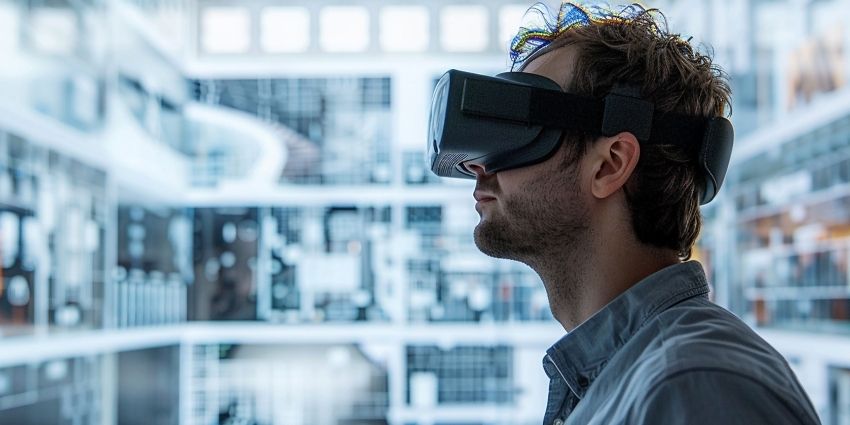
Ambient intelligence: Using XR to kill friction, not to build virtual worlds
Lately, it seems like a lot of claims that “XR” doesn’t pay off in the workplace come from leaders who assume employees have the time and energy to explore exciting new worlds. They don’t.
They’re already feeling the pressure of the infinite workday and getting pinged by colleagues every couple of minutes. Building a new digital workplace doesn’t automatically remove those problems; it just shifts them into a different space.
That’s why ambient intelligence and XR are starting to make more sense in the enterprise. They’re not about building virtual meeting rooms or giving every employee an uncannily accurate avatar. They focus on using the most exciting new tech around: AI and extended reality, to reduce the friction points we face every day, and guide better decisions.
If you care about XR adoption trends (and you should), it might be time to start focusing less on the “metaverse” and more on the tools that improve the universe we already inhabit.
The Shift: From Metaverse To Ambient Intelligence & XR
There’s no shortage of proof that interest in artificial intelligence and extended reality keeps climbing. Wearables are getting easier to live with. Assistants are getting smarter. And enterprise strategies from Meta, Google, and Samsung are finally lining up with how people actually work. That’s why 2026 keeps popping up as a real XR inflection point.
The catch is perspective. Early workplace XR projects treated success like a design problem. Build virtual spaces. Buy the newest headsets. Teach people new behaviors and hope they stick. Ambient intelligence XR flips that logic. Instead of asking work to adapt to technology, it lets technology settle quietly into the work that already exists.
Instead of clunky VR headsets, teams use AI-enhanced smart glasses that feel natural and show prompts and insights at the perfect moment. Rather than stepping into a new “metaverse hub” for training, collaboration, or customer service, teams just access more of the data, visuals, and resources they need in the real world.
This idea is clearly taking off, pushing enterprises to invest more into simpler headsets and ecosystems that combine XR and AI tools automatically, like the Android XR solution. It’s also already proven itself, particularly among front-line and field service teams.
Now, teams are just getting ready to bring simpler interactions, hands-free assistance, and smoother workflows into the workplace at scale.
Defining Ambient Intelligence & XR
To really understand why all of this matters, we need to get real about what ambient intelligence means in the XR space. Compared to some XR initiatives, ambient intelligence is almost dull. It revolves around a few central concepts:
- Context first, interface last: The system already knows where you are, what you’re touching, and which step comes next. Not because someone filled out a form, but because it’s looking at the same scene you are. Vision, motion, and environmental signals do the work so people don’t have to.
- Micro-interventions, not workflows: AI assistants built into tools send short prompts, warnings, or data in real-time. No menus or dashboards, just relevant guidance.
- Natural interactions: Employees interact with tools and AI assistants like they would talk to another person, with natural speech, not scripted prompts. Some systems even respond to gestures.
- Automatic capture that saves people later: Photos, timestamps, and notes get attached to tickets or job records without anyone stopping the job to document it. That alone removes a ridiculous amount of friction.
That’s it, really, invisible XR and AI working together to protect focus. You can see examples of this in a few industries already. Lockheed Martin, for instance, already gives its team smart glasses that help them design, build, and test products faster. People aren’t jumping into new worlds to use them; they’re getting the resources they need on the job.
Why Ambient Intelligence and XR Are Taking off Now
Smart glasses and other XR tools with built-in ambient intelligence haven’t replaced our standard workplace tech yet, but adoption is creeping up, and it’s easy to see why.
First, AI has become a more central part of most XR tools. Platforms are lining up in a way we haven’t seen before. Android XR, Apple’s spatial push, Meta’s AI-first glasses strategy. We’ve got plenty of evidence that the infrastructure is getting built for ambient intelligence to thrive in the workplace.
Secondly, using ambient intelligence feels a lot more natural and requires much less change management than most other XR initiatives. Before now, headsets still depended on interfaces, menus, and buttons. You had to think about the tool before you could use it. Ambient intelligence within the XR operating system changes that.
Gartner took notice, too. Invisible intelligence landed on its list of the top ten strategic technology trends for 2025.
Even before a user does anything, AI built into a set of Meta or Samsung specs can:
- Filter for relevance: Instead of a set of smart glasses showing everything that might matter, the system surfaces what matters now. Wrong part? It flags it. Missed step? It nudges. Everything else stays out of the way.
- Natural interaction without ceremony: People speak. The system listens. No command syntax. No learning curve. That’s why ambient intelligence improves work in a way that earlier initiatives struggled with.
- Short interactions that add up: These aren’t long sessions. They’re five seconds here, ten seconds there. Over a shift, that compounds into fewer mistakes and faster completion without anyone feeling “immersed.”
It’s starting to become obvious that devices like smart glasses aren’t growing in popularity because enterprise teams want futuristic eyewear. They’re becoming more appealing because staff want tools that slot neatly into the work they’re already doing.
The Trust Factor Enterprises Can’t Overlook
Ambient intelligence and XR have a lot to offer businesses. They can make workdays run more smoothly, reduce risk, improve productivity, and even give businesses more of the data they need to power human-led transformation. But there are still risks.
The more helpful and invisible the system becomes, the more sensitive the trust equation gets. When tech fades into the background but still gathers data, businesses need to be cautious.
Stanford even published some insights on this, stating that people will only tolerate ambient sensing when it feels respectful and has boundaries. Wearables and always-on systems get rejected fast when they feel heavy, intrusive, or vaguely surveillant. In healthcare pilots, participants have literally stopped wearing devices when they felt monitored instead of supported.
If you’re going to be using ambient intelligence & XR together, you need to:
- Minimize what you collect, not just how you store it: If the system doesn’t need identity-level data, don’t capture it.
- Make sensing visible, even when the tech is invisible: Clear indicators. Clear zones where capture isn’t allowed. No guessing games.
- Design for bystanders, not just users: Smart glasses don’t just affect the person wearing them. They change the room. People notice. They wonder what’s being captured. If you don’t account for that, discomfort builds.
Get it right, and invisible XR feels like help. Get it wrong, and it feels like surveillance with better optics.
What Ambient Intelligence Changes About Workplace Tool Strategy
Deploying ambient intelligence and XR into the workplace isn’t the same as implementing a new tool; it’s more about adjusting the delivery layer.
Most workplace tech adds surfaces. Another app, dashboard, or place to check. Invisible XR does the opposite. It collapses surfaces and pushes help into the moment where work already exists.
When you take the right approach, a few big things start to change.
Frontline enablement stops being a training problem
Instead of front-loading knowledge into courses, ambient systems drip it out when it’s needed.
- Step-level guidance appears only when someone hesitates
- Safety checks surface before mistakes, not after audits
- Remote expertise arrives without pulling people off the job
PwC’s immersive learning research found that employees trained with AR and VR completed tasks up to four times faster than traditional methods. Learning sticks better when it’s embedded in action, not separated from it.
Knowledge delivery becomes situational, not searchable
Search assumes you know what you’re looking for. Ambient systems assume you don’t, and fix that.
- Instructions show up because the system recognizes the object
- Past fixes surface because the context matches
- Documentation happens automatically, not as an afterthought
That’s not automation for its own sake. It’s a response to how work actually unfolds.
Experience Insights Evolve
When work is enhanced by ambient intelligence, data stops coming only from surveys, tickets, and retrospectives. It starts coming from how work actually unfolds, moment by moment. Leaders can see:
- Where people hesitate
- Which steps trigger repeat prompts
- When guidance gets ignored
- Where errors cluster before anyone files a ticket
- How often workers ask for help versus push through alone
Over time, that changes decision-making in ways most EX tools never touch. Experience design stops being hypothetical, process fixes get prioritized by pain, and support for teams becomes proactive, instead of reactive.
That’s important, because the future of EX isn’t just about more listening tools, it’s about identifying better signals. Ambient intelligence just happens to surface those signals without asking employees to stop and explain themselves.
Employee experience becomes a trust problem, not a feature list
Right now, employee connection is becoming a core KPI, especially in hybrid and frontline-heavy organizations. Tools that help quietly can strengthen that connection. Tools that feel extractive weaken it fast.
The strategic implication is uncomfortable but simple: If ambient intelligence feels like surveillance, adoption dies. If it feels like backup, people lean in.
That’s why the smartest teams stop asking, “Where do we deploy XR?” and start asking, “Where does work break down, and how can intelligence show up there without stealing attention?”
Adopting Ambient Intelligence without Harming Trust
Honestly, you don’t “roll out Ambient intelligence and XR.” You sneak it into the cracks where work already breaks. The starting point is easier than you’d think:
- Start with one workflow that already hurts: Repeat visits. Rework. Training that never quite lands. If people complain about it in Slack, it’s a candidate.
- Design for five-second wins: If the value isn’t obvious in under a minute, it won’t survive the day. A prompt before a mistake. A quick confirmation. A captured note that saves a call later.
- Pilot small and visible (in a good way): Ten to twenty users. One team. Clear rules. Clear opt-in. Measure outcomes that finance and operations both respect: time-to-complete, first-time-fix, error rates, and time-to-competence.
Also, you don’t have to start with “cutting-edge” technology straight away. A lot of organizations ease in with AI-enhanced mobile AR or WebAR before moving to wearables. That makes sense, since smart glasses aren’t everyone’s default device yet.
Unlocking Opportunities with Ambient Intelligence and XR
Most people don’t start their day hoping for new tech at work. They’re hoping the day feels a little less jagged than the one before. Fewer hiccups. Fewer small problems turning into big ones. That’s why the metaverse didn’t really vanish. It just stopped feeling useful. Teams aren’t chasing new worlds. They want the one they’re already in to run a bit smoother.
When you look at XR adoption trends, that’s the pattern hiding in plain sight. The tech that lasts isn’t exciting in isolation. It’s useful in motion, and it earns trust by staying out of the way.
If you’re ready to discover what XR can really do for your business, beyond the metaverse, our guide to the impact of extended reality for the enterprise is a great place to start learning.