

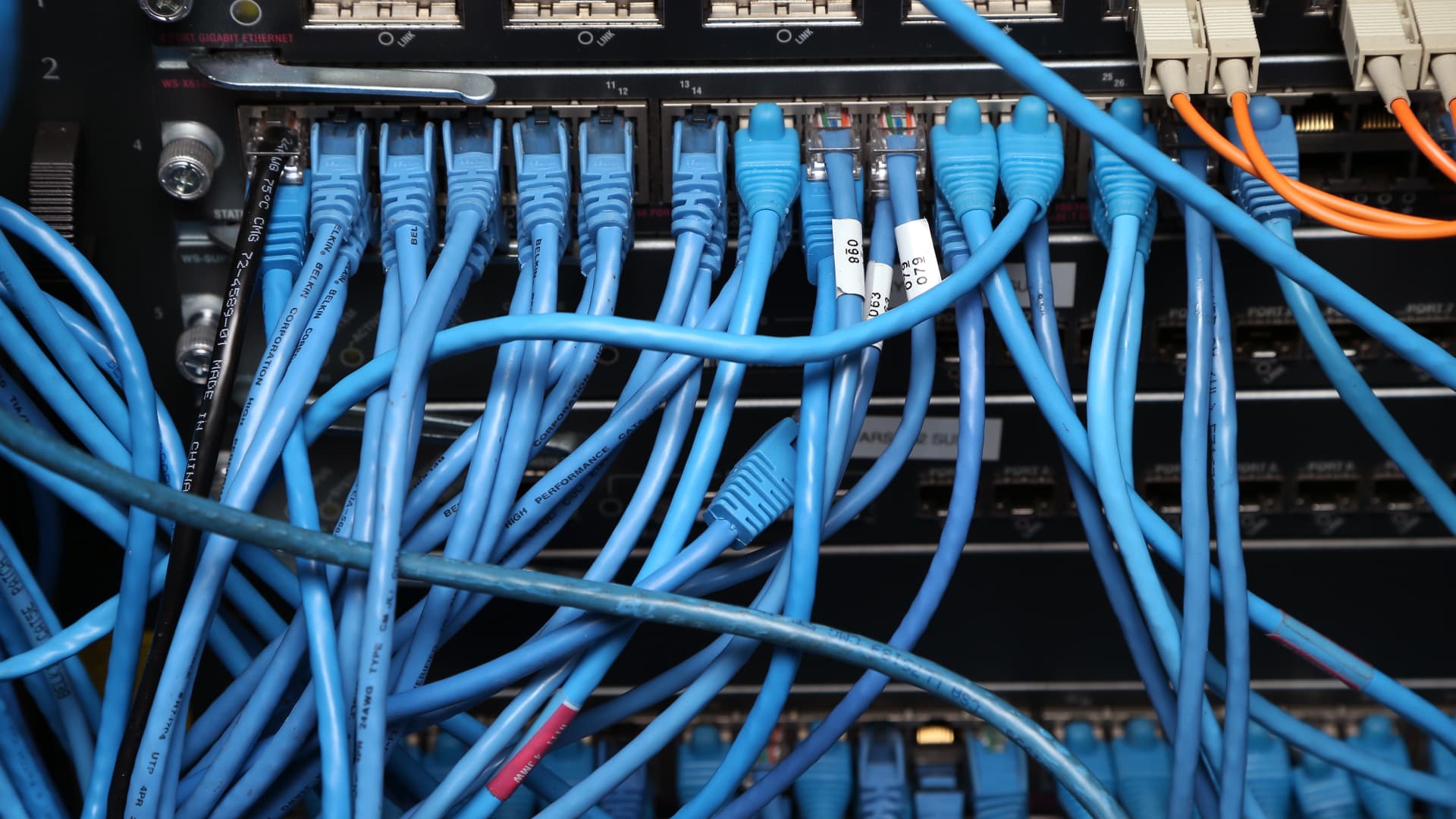
Network cables are plugged in a server room.
Michael Bocchieri | Getty Images
In Europe, the battle between U.S. Big Tech companies and telecommunications firms has reached fever pitch.
Telecom groups are pushing European regulators to consider implementing a framework where the companies that send traffic along their networks are charged a fee to help fund mammoth upgrades to their infrastructure, something known as the “sender pays” principle.
Their logic is that certain platforms, like Amazon Prime and Netflix, chew through gargantuan amounts of data and should therefore foot part of the bill for adding new capacity to cope with the increased strain.
“The simple argument is that telcos want to be duly compensated for providing this access and growth in traffic,” media and telecoms analyst Paolo Pescatore, from PP Foresight, told CNBC.
The idea is garnering political support, with France, Italy and Spain among the countries coming out in favor. The European Commission is preparing a consultation examining the issue, which is expected to launch early next year.
‘Free riding’
The debate is hardly new. For at least a decade, telecom firms have tried to get digital juggernauts to fork out to support upgrades to network infrastructure. Carriers have long been wary of the loss of income to online voice calling applications such as WhatsApp and Skype, for example, accusing such services of “free riding.”
In 2012, the European Telecommunications Network Operators Association lobby group, which counts BT, Vodafone, Deutsche Telekom, Orange and Telefonica as members, called for a solution that would see telecom firms strike individual network compensation deals with Big Tech companies.
But it never really led to anything. Regulators ruled against the proposal, saying it might cause “significant harm” to the internet ecosystem.
After the coronavirus outbreak in 2020, the conversation shifted. Officials in the EU were genuinely worried networks might crumble under the strain of applications helping people work from home and binge films and TV shows. In response, the likes of Netflix and Disney Plus took steps to optimize their network usage by cutting video quality.
That revived the debate in Europe.
In May 2022, EU competition chief Margrethe Vestager said she would look into requiring Big Tech firms to pay for network costs. “There are players who generate a lot of traffic that then enables their business but who have not been contributing actually to enable that traffic,” she told a news conference at the time.
Meta, Alphabet, Apple, Amazon, Microsoft and Netflix accounted for more than 56% of all global data traffic in 2021, according to a May report that was commissioned by ETNO. An annual contribution to network costs of 20 billion euros ($19.50 billion) from tech giants could boost EU economic output by 72 billion euros, the report added.
Broadband operators are investing seismic sums of cash into their infrastructure to support next-generation 5G and fiber networks — 50 billion euros ($48.5 billion) a year, per one estimate.
U.S. tech giants should “make a fair contribution to the sizable costs they currently impose on European networks,” the bosses of 16 telecom operators said in a joint statement last month. Higher prices of fiber optic cables and energy have impacted operators’ costs, they said, adding greater impetus for a network access fee.
The debate isn’t limited to Europe, either. In South Korea, companies have similarly lobbied politicians to force “over-the-top” players like YouTube and Netflix to pay for network access. One firm, SK Broadband, has even sued Netflix over network costs associated with the launch of its hit show “Squid Game.”
The larger picture
But there’s a deeper story behind telcos’ push for Big Tech payments.
While overall revenues from mobile and fixed-line services are expected to climb 14% to 1.2 trillion euros in the next five years, telecoms services’ monthly average revenue per user is forecast to slip 4% over the same period, according to market research firm Omdia.
The Stoxx Europe 600 Telecommunications Index, meanwhile, has declined more than 30% in the past five years, according to Eikon data, while the Nasdaq 100 has risen over 70% — even after a sharp contraction in tech stocks this year.
Telcos today serve as everyday utilities rather than the household brands that sold the hottest gadgets and services — like Nokia with its iconic cell phone brand. Faced with a squeeze on profits and dwindling share prices, internet service providers are seeking ways of making additional income.
Video services have driven an “exponential growth in data traffic,” according to Pescatore, and better picture formats like 4K and 8K — coupled with the rise of short-video apps like TikTok — mean that growth will “proliferate” over time.
“Telcos do not generate any additional revenue beyond the connection for providing access whether that is fibre or 4G/5G,” Pescatore said.
Meanwhile, the push toward the “metaverse,” a hypothetical network of huge 3D virtual environments, has both excited telcos about the business potential and caused trepidation over the mammoth data required to power such worlds.

While a “mass market” metaverse has yet to be realized, once it does, “its traffic would dwarf anything we see now,” Dexter Thillien, lead technology and telecoms analyst at The Economist Intelligence Unit, told CNBC.
Should traffic senders pay?
Tech companies, naturally, don’t think they should pay for the privilege of sending their traffic to consumers.
Google, Netflix and others argue that internet providers’ customers already pay them call, text and data fees to make investments in their infrastructure, and forcing streamers or other platforms to pay for passing traffic could undermine the net neutrality principle, which bars broadband providers from blocking, slowing or charging more for certain uses of traffic.
Meanwhile, tech giants say they’re already investing a ton into internet infrastructure in Europe — 183 billion euros between 2011 to 2021, according to a report from consulting firm Analysys Mason — including submarine cables, content delivery networks and data centers. Netflix offers telcos thousands of cache servers, which store internet content locally to speed up access to data and reduce strain on bandwidth, for free.
“We operate more than 700 caching locations in Europe, so when consumers use their internet connection to watch Netflix, the content doesn’t travel long distances,” a Netflix spokesperson told CNBC. “This reduces traffic on broadband networks, saves costs, and helps to offer consumers a high-quality experience.”
There’s also the matter of why internet users pay their providers in the first place. Users aren’t driven by which operator keeps them connected; they want to access the latest “Rings of Power” episode on Amazon Prime or play video games online — hence why telcos increasingly bundle media and gaming services like Netflix and Microsoft’s Xbox Game Pass into their deals.
The Computer and Communications Industry Association lobby group — whose members include Amazon, Apple and Google — said calls for “sender pays” fees were “based on the flawed notion that investment shortfall is caused by services that drive demand for better network quality and higher speeds.”
At a September event organized by ETNO, Matt Brittin, Google’s president of Europe, said the proposal was “not a new idea, and would upend many of the principles of the open internet.”
No clear solution
A fundamental issue with the proposal is that it’s not clear how the payments to telecom companies would work in practice. It could take the form of a tax taken directly by governments. Or, it could be private sector-led, with tech firms giving telcos a cut of their sales in proportion to how much traffic they require.
“That’s the biggest question mark,” Thillien said. “Are we focusing on volume, the percentage of traffic from certain websites, what will be the cut-off point, what happens if you go over or under?”
“The looser the rules, the bigger number of companies can become liable for payment, but the stricter, and it will only target a few (which will be American with its own geopolitical implications),” he added.
There’s no easy solution. And that’s led to concern from tech firms and other critics who say it may be unworkable. “There’s no one single bullet,” Pescatore said.
Not all regulators are on board. A preliminary assessment from the Body of European Regulators for Electronic Communications found no justification for network compensation payments. In the U.K., the communications watchdog Ofcom has also cast doubts, stating it hadn’t “yet seen sufficient evidence that this is needed.”
There are also concerns relating to the current cost-of-living crisis: if tech platforms are charged more for their network usage, they could end up passing costs along to consumers, further fueling already high inflation. This, Google’s Brittin said, could “have a negative impact on consumers, especially at a time of price increases.”