

A software program called a web service enables computer-to-computer communication over the internet. However, web services are nothing new and typically take the form of an application programming interface (API). The Web is a collection of related hypertext materials that may be accessed online. For example, a user examines web pages that may contain multimedia using a web browser and uses hyperlinks to move between them.
Tim Berners-Lee, who was employed by CERN, The European Organization for Nuclear Research, in Geneva, Switzerland, invented the Web in 1989. Since then, Berners-Lee has actively directed the development of web standards and has pushed for the creation of the Semantic Web, also called Web3.
The phrase “Web3” is used to characterize multiple evolutions of web interaction and usage along various paths, including creating a geospatial web, utilizing artificial intelligence tools and making content available through numerous non-browser apps or Web3 browsers. A Web3 browser introduces users to a new world of decentralized apps (DApps) and digital economies.
This article will discuss Web3 fundamentals, key features of a Web3 browser, how a Web3 browser works and how to use one.
What is a Web3 browser?
Web3 browsers help users interact with decentralized applications built on blockchain technology. Web3 technologies like distributed ledgers, artificial intelligence, Metaverse and others aim to create the next-generation internet, which is accessible to everyone and offers benefits.
Key features of a Web3 browser include:
- Immutable ecosystem, i.e., trust that people will download the digital product just as the original creator intended.
- Enhanced transparency and security,
- Quicker browsing performance,
- Complete user anonymity and confidentiality,
- Integrating cryptocurrency wallets with multiple blockchains,
- Complete control over the content due to decentralization.
Furthermore, search engines can find microcontent texts automatically tagged in Web3, calling for converting countless macro Web1 content into microcontent. Because tagging can somewhat eliminate the uncertainty that homonyms and synonyms introduce to the search process, the end result may be a more accurate search.
How does a Web3 browser work?
The world of DApps and digital economies is made available by Web3 internet browsers. By leveraging cryptography and public blockchains, the Web3 browser places control with users, wiping out centralized institutions. Additionally, consumers are rewarded financially for interacting with content or viewing carefully selected adverts on decentralized social media platforms and Web3 browsers.
But, how do Web3 browsers change the online experience? Web3 browsers enable users to use the standard functionality of browsers. They are essentially decentralized applications that allow users to retain ownership of their data and share its revenue. So, is Chrome a Web3 browser? No, Chrome is a Web2 browser like Firefox and Safari. However, users can access Web3 applications with Web2 browsers using a Web3 wallet like MetaMask.
How to use a Web3 browser?
The Web3 wallets can be incorporated into traditional web browsers, providing DApp browser functionality by allowing flexible access to decentralized applications without the assistance of other intermediaries while still maintaining full ownership of their assets. In addition, users can access the Web3 economy without going through any Know Your Customer (KYC) or Anti-Money Laundering (AML) procedures.
Moreover, crypto assets can be stored and managed effectively using Web3 wallets. However, if one loses their seed phrase, they may lose funds, unlike centralized custodial wallets. So, which Web3 browser would be suitable for your requirements? Let’s learn about various Web3 internet browsers in the sections below.
Opera Web3 browser
Both crypto-curious and blockchain-savvy users may enjoy a seamless, private and secure Web3 experience with Opera Crypto Browser with features such as phishing protection, a secure clipboard, a malicious-address checker and the Wallet Selector, the industry’s first multi-wallet management tool. Ether (ETH), ERC-20 and ERC-721 tokens are supported by the built-in crypto wallet and several blockchains, including Ethereum Virtual Machine (EVM)-compatible chains, Bitcoin and layer-2 solutions. Additionally, Opera has a strong partner network with partners like Solana or Polygon across the crypto ecosystem.
Furthermore, users can quickly access WhatsApp, Telegram, Discord, Twitter and more social apps in the sidebar of the desktop Crypto Browser to stay connected to their communities at all times. In addition, users may access future airdrops, industry updates and event calendars, gas costs, instructional content and others through the integrated Crypto Corner.
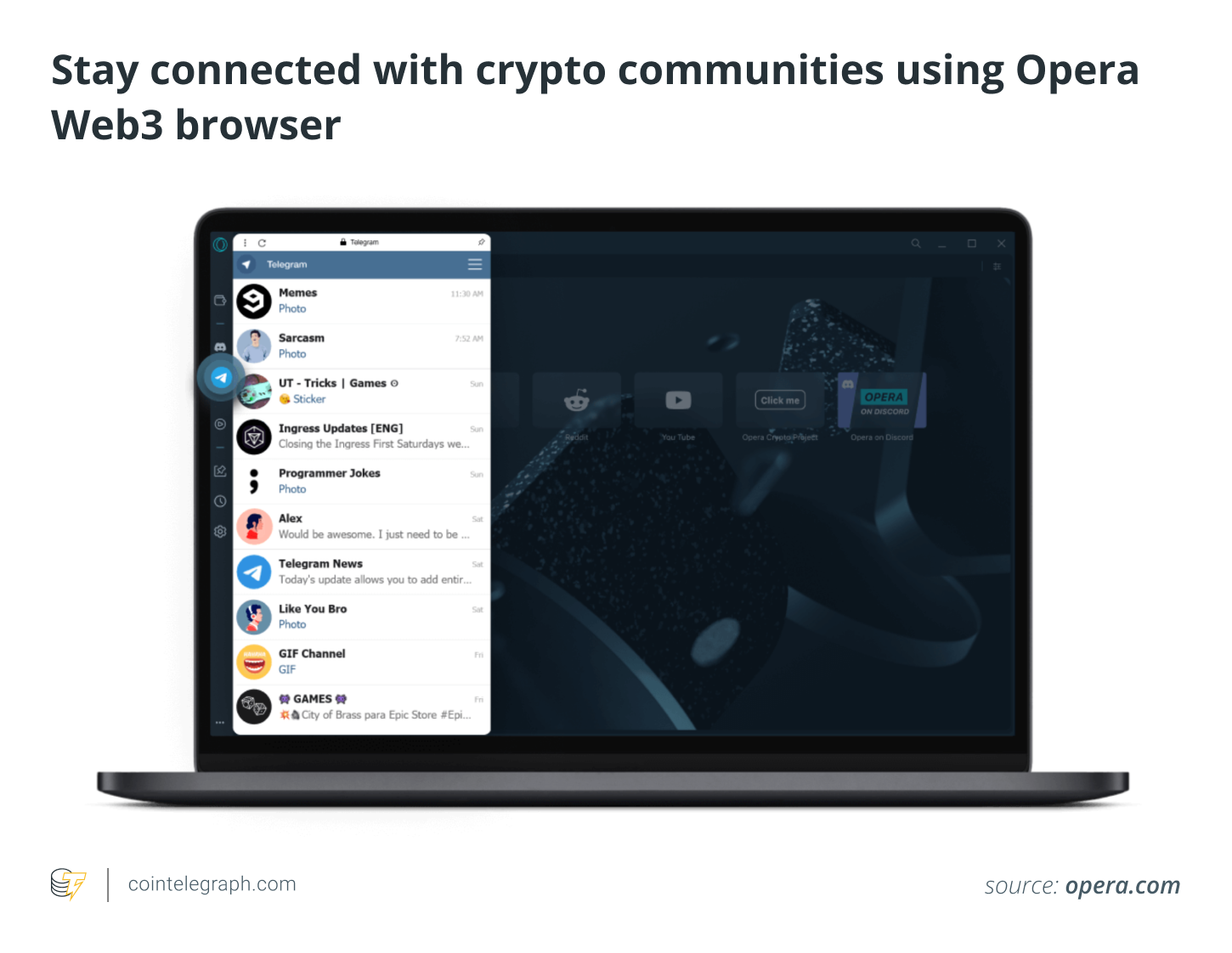
If you are interested in using the Opera Web3 browser, you must first download the Opera Crypto Browser for Android, Windows, or Mac (iOS coming soon). Then, if you already have a wallet, you can use it or create an Opera wallet to utilize the functionalities mentioned above.
Puma Web3 browser
Ukrainian-Canadian developer Yuriy Dybskiy founded Puma Browser in January 2019. It provides access to Ethereum Name Service (ENS) and Handshake (HNS) domains and InterPlanetaryFileSystem (IPFS), as well as seamless payments for content creators, app and game developers via Coil Content Network and Interledger Protocol. Using the Puma browser, web monetization works as follows:
- A monthly charge of $5 is paid by Coil Members to access the content created by the users.
- Interested users set up a digital wallet and make money from their content. Every hour a Coil Member spends viewing users’ content earns them $0.36 from Coil.
- While Coil Members enjoy users’ content, Coil streams funds to their wallets.
Brave Web3 browser
Brave is open-source software that offers privacy-preserving features together with a free-to-use business model. It enhances users’ browser super app with cost-free video calls, fully autonomous search, offline playlists and even a personalized news feed. Brave, by default, bans trackers and obscene advertisements on all websites users visit. Moreover, Brave’s brand-new nonfungible token (NFT) gallery feature provides users with a streamlined interface for viewing and managing NFT collections.
Additionally, by watching ads, one can earn passive income in Basic Attention Tokens (BAT). Another notable feature of the Brave Web3 browser is the incorporation of IPFS functionality, which enables built-in decentralized file storage and reduces data concentration by distributing file storage across a worldwide network.
Beaker browser
Beaker browser allows peer-to-peer website hosting, referred to as Hyperdrives, in a private mode. Only those with the link to a Hyperdrive can access the website once it has been created. To create hostless applications, the Beaker browser offers new APIs while still being compatible with the rest of the Web.
Beaker displays the complete site’s structure in a GitHub-like format, in contrast to most browsers showing the page’s source code to the website visitors. Even better, one can host their own fork of the website.
Osiris browser
The first net-neutral browser in the world, Osiris hopes to release people from commercialism, the shackles of censorship and bias that have crept into the internet. Osiris asserts that it is a blockchain-based browser that, by default, bans all commercials and trackers and states baldly that it is self-sustaining without advertising money.
With Osiris Armor, users can configure privacy settings and view the number of advertising and scripts that have already been banned. In addition, it offers a multi-wallet called Metawallet that embeds a wallet in the browser and supports several cryptocurrencies to enhance the Web3 experience for blockchain users.
The future of Web3 browsers
Web platforms have long been without the capability of money transfer, resulting in a deluge of internet advertising and dishonest business practices. As the Semantic Web (Web3) promises to arrange the world’s information in a way that Google’s search engine architecture cannot achieve, it enables web monetization opportunities for developers, gamers, and content creators. Web monetization offers an effective, free, native and automatic means of paying creators, funding essential web infrastructure and supporting API calls.
Although Google Chrome is the most used Web2 browser and DApps can be accessed via Web3 wallets, blockchain-friendly web browsers allow users to control their data, funds and assets without intermediaries. Therefore the shift towards decentralized web calls for novel and innovative solutions to enhance the user experience, and Web3 browsers acting as a gateway to DApps are essential to access the digital economy.
Despite the fact that there are still many unexplored areas of the Semantic Web and a lot of research to be done, it is evident that Web3 technologies are becoming a significant force in the current Web landscape. And it is expected that Web3 browsers (both existing and upcoming ones) will continue to offer distinct services to serve the needs of blockchain users.