

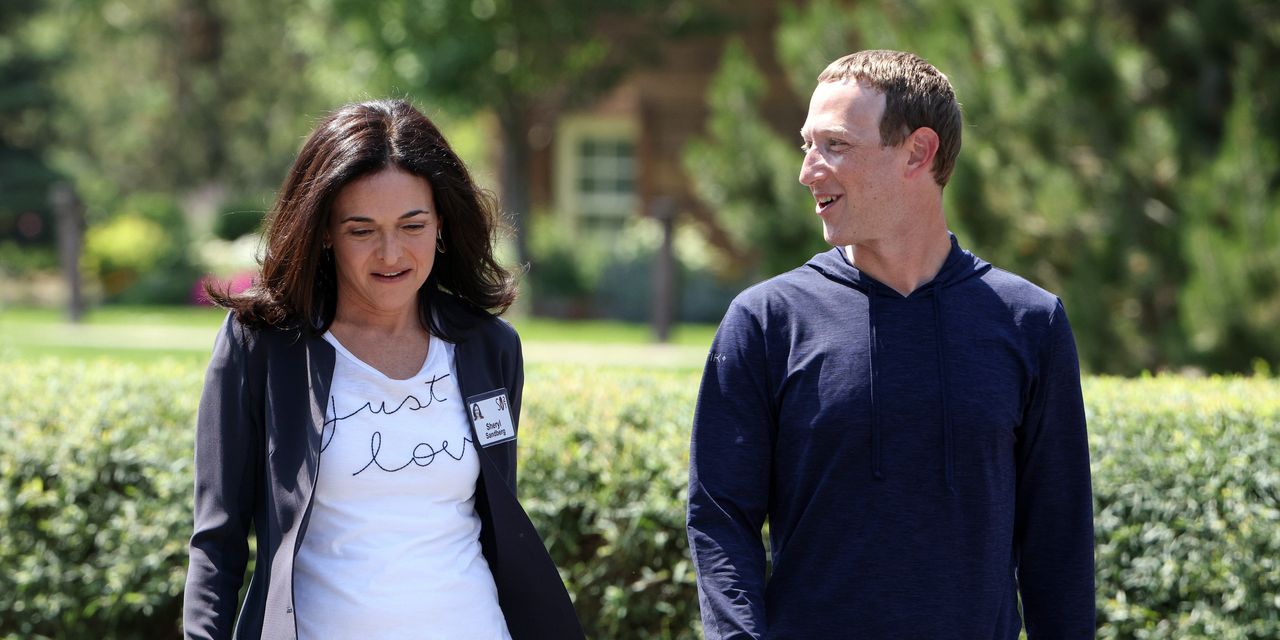
In the sea of “Metamates,”
Sheryl Sandberg
is either jumping ship or is being pushed overboard. Either way, the company formerly known as Facebook—under a new name and bound for a new destination—has the same captain. And he will be fully responsible for the voyage from this point onward.
In a Facebook post on Wednesday, Ms. Sandberg said she was stepping down from her role as
Meta’s
chief operating officer after 14 years at the company. Her stated reason was to focus more on her family and philanthropic work, but the move comes at a delicate time for an advertising business that she headed—and still accounts for 97% of the company’s revenue.
That ad business is going through some of its greatest challenges yet, through a combination of factors like the slowing economy, changes on
Apple’s
mobile operating system and increased competition from TikTok. Wall Street expects Meta’s advertising revenue to grow just 6% this year after averaging 44% annual growth over the last 10. Meta’s stock price slipped nearly 3% Wednesday afternoon after Ms. Sandberg’s announcement.
Still, the departure shouldn’t be entirely surprising. Credited with guiding Meta’s advertising business from zero to the $115 billion behemoth it is today, Ms. Sandberg has long served as a valuable right hand to chief executive officer
Mark Zuckerberg.
But while she gave the then-23-year-old co-founder an important shot of credibility in the early days, her star seemed to have dimmed of late.
An analysis by The Wall Street Journal last year found the share of the company’s staff reporting to Ms. Sandberg declined in recent years while other managers such as chief growth officer
Javier Olivan
saw their share rise. The company said Wednesday in a filing that it expects to name Mr. Olivan to the COO role following Ms. Sandberg’s transition.
But despite an apparent power shift internally, Ms. Sandberg consistently served a very powerful position as Meta’s fall-person during what lately has been near-constant crisis. She has publicly defended Meta’s platforms on a host of issues, from alleged election interference to alleged instigation of violence. In October, the Journal reported the company’s legal team, under Ms. Sandberg, had in the previous year grown about 60% faster than the company overall amid antitrust challenges, shareholder lawsuits and other legal problems.
In a Bloomberg interview published Wednesday she alluded to these efforts, noting her role at Meta has been “not the most manageable job anyone has ever had.” As a 52-year-old mother, she provided a nice public foil to the much younger Mr. Zuckerberg who still candidly admits his company’s early days were founded on the somewhat juvenile premise to “move fast and break things.” Her age, experience and arguably even her gender all helped Facebook gain broader credibility outside the narrow world of Silicon Valley.
The question now is whether Mr. Zuckerberg will stay the course or rock the boat without Ms. Sandberg’s anchor. While Meta has the social network industry’s largest advertising business as its backbone, it is rapidly trying to remake itself into a “metaverse” company through its recent name change and stepped-up investments in virtual reality and related technology. Those moves suggest Mr. Zuckerberg’s need for speed hasn’t exactly changed. In a recent interview with investor and podcaster Tim Ferriss, Mr. Zuckerberg called moving fast the key to learning. He said that, while it used to feel bad to be misunderstood, he now feels “complacent” if he is doing something “too well understood for too long.”
Exactly how on board Ms. Sandberg was for Mr. Zuckerberg’s next journey may remain a mystery; the word metaverse notably went unused in her 1,500-word departure post. She did dedicate some space to detailing how she joined Facebook under the premise that she and Mr. Zuckerberg would sit next to one another. Lately, we have seen a lot of footage of Mr. Zuckerberg’s avatar in virtual reality meetings bobbing next to that of his Chief Technology Officer
Andrew Bosworth.
Ms. Sandberg’s avatar has been notably absent from the table.
The reality is that Facebook—and now Meta—has always been Mr. Zuckerberg’s ship, by virtue of his controlling shares. But the loss of a highly visible first mate still means he will have one less person with the stature to advise him, and share in the blame if he steers the ship wrong. Investors who have sent the stock down 44% already this year may be realizing that now as well.
Write to Laura Forman at laura.forman@wsj.com and Dan Gallagher at dan.gallagher@wsj.com
Copyright ©2022 Dow Jones & Company, Inc. All Rights Reserved. 87990cbe856818d5eddac44c7b1cdeb8